
Cheating Robots
Newsletter 2025-11-24

It took a robot to teach me what I like (and don’t like) about humans.
The cheater set up shop behind me. I was sitting on the periphery of the robotics competition in the comfiest chair I could find. Beyond me, there was a roped-off vending machine area used during work hours when the section was a shared break space for a multi-tenant commercial building. Saturday, the whole floor was transformed into a robotics battle ground. The event had the theme of empowerment and was designed to get more girls interested in STEM. The adult woman behind me felt a little too empowered. Proudly wearing the school shirt of her team, she pulled out an electric cutting tool. Sparks flew in the dim break space. Her students stood around, indifferent to what was happening. They were just there for plausible deniability. Only kids were supposed to touch the robot, a rule designed to prevent this very scenario. This grown-up was cheating at an event whose whole purpose was to teach kids what they were capable of doing on their own. People are the worst.
How did I respond to this grave transgression? By doing nothing. I wasn’t there to be a referee or a champion of righteousness or the implementor of vigilante justice. I was there for my thirteen-year-old, Mae. She had built a robot with her teammates to stack colored cones. Saturday was her chance to show it off. The worst thing I could do was embarrass her. This is her second year in her school’s robotics club. I hope the activity will teach her to love the hard sciences and make her aware of new career opportunities. Whether or not she and her team lost a robotics match on a random Saturday was irrelevant to that goal. They were better off to lose doing the work themselves than to win with an adult doing everything for them. And I was better off not starting an unsolicited and confrontational conversation with a total stranger. I would let Mae’s self-made robot do the talking for her. My main goal for the day was to not talk at all.
My kids have friends. That’s great. Those kids have parents. Again, that’s wonderful. The fewer orphans, the better. I mean that in the sense that I want kids to have parents, not that I want to kill parentless children. This is exhibit A for why I can’t be trusted to strike up conversations, confrontational or otherwise. Sometimes, I have to meet other kids’ parents. Insert the record scratch here. It’s one thing to meet some other kid’s mom or dad if my daughter is going over to their house. A little screening never hurt anyone. Not that I can learn a lot about you by talking for thirty seconds and then forgetting your name as soon as I walk away. I guess I’m checking to see if your house is currently on fire or part of an active murder investigation. If not, I tell my kid to have fun. I’ll be back in two hours.
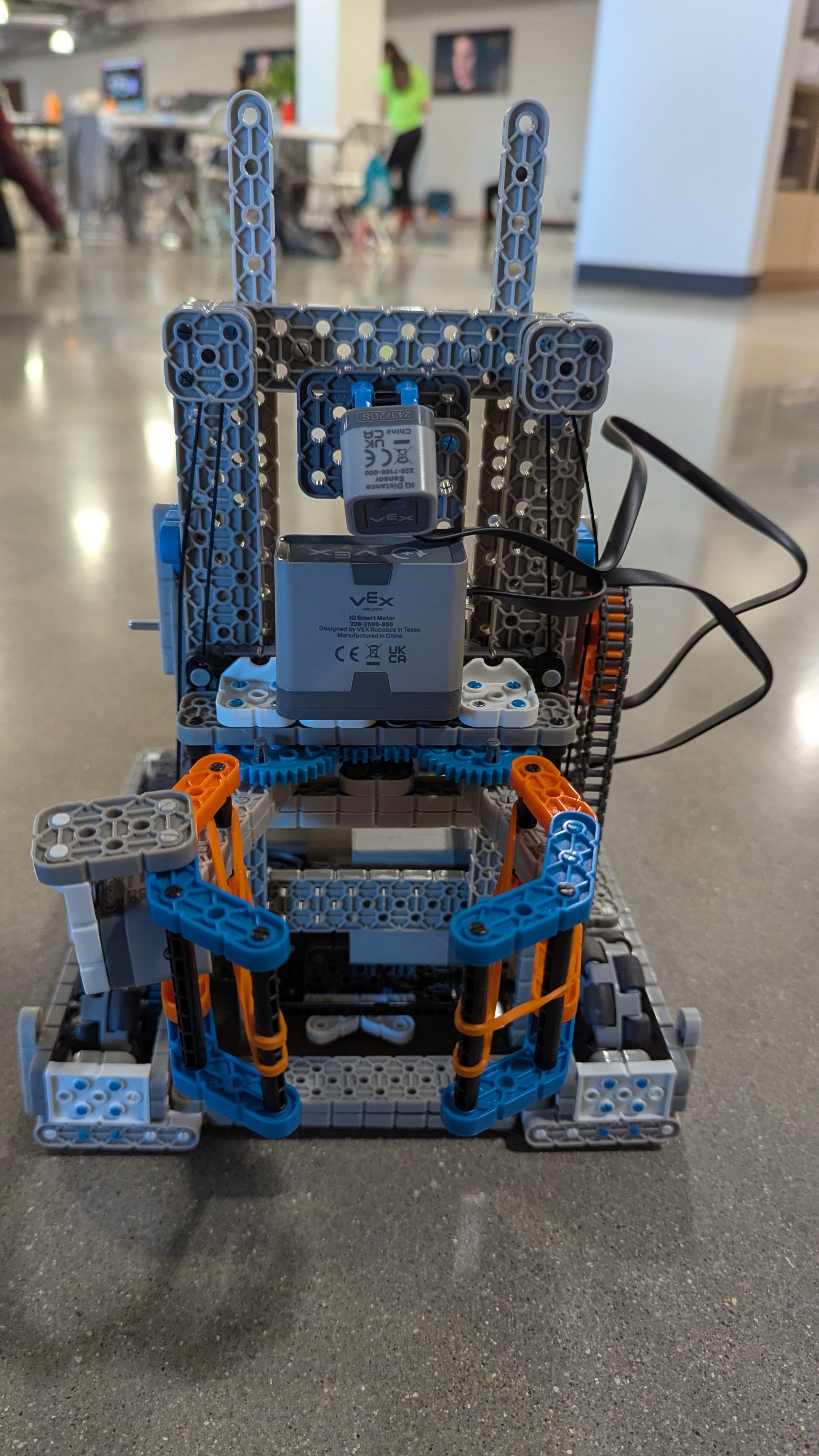
The problem is hostage situations like an all-morning robotics competition. Like most extra curricular activities, it’s a neutral-site event where adults who don’t know each other are trapped together for hours. None of us want to be there. Okay, we want to be there for the small portion when our own offspring are competing. The rest of the time, we’re being held against our will. Given the duration and proximity, it’s basically mandatory that we interact with each other. That’s a challenging situation for social etiquette. I don’t want to be rude and pretend the other parents don’t exist. On second thought, that’s exactly what I want to do, but I won’t. We live in a society. I depend on my fellow humans for food, clothing, and shelter. As much as I joke about becoming a hermit in the woods, I’d be dead within a few hours. That’s about how long it would take me to run out of cereal. I play by the rules so I don’t get exiled. That doesn’t mean I enjoy the game at all.
Mae’s challenge for the day was to make her robot stack colored cups. Mine was to avoid eye contact and small talk. I failed immediately. The teacher leading Mae’s robotics team took the cruel step of introducing me to her teammates’ parents. From that point forward, we sort of knew each other. We couldn’t stand around without saying something. That’s when I retreated to the chair on the edge of the giant room.
A few years ago, I would have welcomed the chance to meet a bunch of local strangers who couldn’t escape me. I was in the market for friends. After years of isolation when all I did was work, wrangle kids, and write, I wanted human companionship. I used board games as bait to build up a roster of people who would show up when I called. Well, when I texted. The fastest way to chase people away is to reach out using my voice. After a few false starts, I found my people. I cheated a little. My brother-in-law and sister-in-law were already locked in by marriage. That made introductions easy. After that, I brought in two new recruits. I used to work with Peter, and he’s married to Delilah. I prefer to bring in couples. It doubles the efficiency of the onboarding process. I invited over many other people at many other times, but those four showed up almost every time I called. That filled all of my empty entertaining spots. There are only so many days in a week. Adding more friends would mean spending less time with my current ones. The pro-social decision was to be anti-social toward all new encounters. That suited me just fine.
Now, when I encounter new people, I’m civil, but I don’t need to build a lasting connection. I’m never going to reach out to them after the end of whatever social engagement is currently requiring us to both be in the same place at the same time. Our relationship is strictly transactional. Before I engage with anyone new, I asked myself two questions: 1) Am I ever going to be stuck in a similar situation with you again? 2) Are you more interesting than my phone? If the answer to both of those questions is no, I’ll keep the conversation as superficial as possible. Both of us will forget about the other person as soon as we leave each other’s direct line of sight. Object permanence isn’t as permanent as you might think.
If I didn’t want to start a conversation on neutral topics, I certainly didn’t want to confront a stranger about cheating, especially when the stakes were so low. It’s not like the playing field was even from the start. Mae and her team were using the default kit with the default layout. Adult YouTubers make better configurations and sell the blueprints for hundreds of dollars. Many schools showed up with those premium models. It didn’t prove which kids could come up with the best design; it showed which grown-ups were willing to spend the most. I wasn’t overly outraged at the inequality. It was a good metaphor for life. We might like to think our kids are going out into the world on even footing with their peers, but in reality the rich have a huge advantage. In the case of the cheating coach, that extra edge can backfire. The rich kids with fancy blueprints and unscrupulous adult leaders might win today, but they’ll learn less than Mae and her friends who had to figure things out on their own. That will give the underdogs a leg up in college and the job market. Unless the rich kids’ rich parents own the companies with the jobs. Then the wealthy will win again. I guess it’s my fault for not getting rich. Actually, no. It’s my children’s fault for not being born rich. They should have chosen better parents.
Instead of starting an unpleasant conversation, I punished the opposing coach by silently thinking less of her. It’s the same treatment I assume I’m always getting from other people, even though they barely think about me at all. Likewise, I barely think about them. If the cheating coach changed out of her school polo, I wouldn’t be able to pick her out of a lineup. That’s because of a character flaw in me rather than her. A few weeks ago, I was walking down a hallway when a stranger began waving enthusiastically in my direction. I looked behind me to see if they were trying to get someone else’s attention. A day later, I realized it was someone I knew. I didn’t recognize her because she got a haircut. With a memory like that, my grudges carry little weight. I need to take pictures to remember who I’m supposed to be mad at.
After I wrote that last paragraph, I summoned Mae to ask her when she thought she would compete. That’s when the stranger sitting next to me realized we were dads of girls on the same team. He hadn’t been there when the teacher made the initial introductions. Now, conversation was inevitable. I braced myself. To my horror, he was both interesting and impressive. He was a firefighter. I asked if he responded to the fire at Onyx’s home. He remembered hearing the call—there are only so many blazes involving a house pig—but his unit hadn’t been ordered to the scene. When I told him that the house sat vacant for a year before any repair work was done, he wasn’t surprised. He knew of one other house in our suburb that had a similar wait. Maybe all house fire victims are severely mistreated by the insurance industry. I wouldn’t have learned that interesting tidbit if I hadn’t been forced into an unwanted conversation in unwanted circumstances. Communicating opened up a little bit of the world to me. Then again, had I been browsing my phone instead, I might have learned something about the world, too. I could have been reading Wikipedia or watching educational videos. I definitely wouldn’t have just been streaming Facebook reels like I do every other minute of my free time.
Despite all my dread about interacting with other humans at the event, Mae had the opposite experience. She was having a blast with her friends. They had spent time after school for weeks working together to build the robot and practice controlling it. Their communication skills were finely honed. That’s where they shined. As part of the competition, the kids were interviewed about the robot and the scientific principles behind it. The event organizers wanted to make sure the children understood the concept and didn’t just sit back while their parents and teachers did all the work. Mae’s team got 44 out of 45 possible points on the interview section. Mae is good at science but better at talking. Based on how loud my house is, that tracks. May the world never silence her.
Unfortunately, the interview portion wasn’t scored. This was an unofficial exhibition event where only the cup stacking section counted. Mae’s robot doesn’t have a future as a waiter or a bus boy. Her group didn’t win. More importantly, the cheaters didn’t, either. If crime doesn’t pay, you’re bad at being a criminal. Mae learned she does well in interviews and can handle situations on her own. I learned that insurance companies are unreliable even for home owners who don’t own pigs and also that the parents of other kids might have random useful information. The robot learned that, even if it doesn’t have a soul, it can still find love. There was an entire robot subplot that I forgot to write about. Maybe next week.
Anyway, that’s all I’ve got for now. Catch you next time.
James
So glad Mae had fun and good for her with the interview! She is a wordsmith like her dad. Woman ARE unfortunately silenced in a lot of ways, even in this "modern" time. Your girls and hopefully mine are leading the way to a different future.
I've also witnessed cheating by parents at school stuff. Disappointing. You were smart not to engage. I'm essentially an introvert, and being "stuck" with other parents over the years was good for me, too. Always good to know more people in your kid's wider circle I suppose. We NEED the robot love story...
We may be long lost twins on the social interactions front. I would’ve rather hid under the bleachers than attempt small talk.
The strong interview and communication skills will serve Mae very well in the future.