
Out-Competed
Newsletter 2026-01-26

“It’s not whether you win or lose, but how you play the game.” That’s loser talk. A more accurate saying would be, “It’s not whether you win or lose, but how much you win by and how much you gloat afterwards.” This is evident in the kinds of shows streaming today. Singing, cooking, and even renovating houses have been transformed into cutthroat reality TV competitions. Renovating anything is hard enough on its own without racing an opposing team that’s trying to outdo you. When I replace a toilet, it’s already me against the universe without adding any other challengers. Fluid dynamics will forever be my mortal enemy. Today, two of my kids are engaged in what I would consider friendly activities but what the world considers scored contests for fame and glory. My fifteen-year-old, Betsy, is in an all-day show choir competition, while my thirteen-year-old, Mae, is squaring off over robotics. You can’t just sing a song or build a robot on your own anymore. You have to do it for points so you can be measured against your peers. There can’t be winners if there aren’t losers. In this case, the biggest losers are the parents who spent half the weekend stranded at schools in other cities. The only win we’re hoping for is that both events end early and everyone can get home before the approaching ice storm. If not, I hope Mae can build a robot that will get us out of a ditch.
I’m writing this on Saturday from the robotics competition. I had to wake up early to make the forty-five minute drive with Mae. When we got here, Mae said she doesn’t even like the competitions. She enjoys meeting up with her friends after school to build and program the robot. She could do without the actual part that’s for points. That was a delightful thing to hear after I’d already committed half of my weekend to watching her robot stack cups. Betsy, on the other hand, likes her competitions, but that’s because they give her a chance to hang out all day with her friends. If she were in a singing and dancing troupe that never competed but occasionally put on shows, she would still sign up, but her enthusiasm would be slightly lessened. She wants to win trophies as big as she is. I could use that. I should buy the biggest trophy in the world but only give it out to my kids if they put away their laundry.
I understand why competitions are necessary. It gives groups a goal and a deadline. For robotics, the builders can’t endlessly iterate and experiment. They have to lock down a design that works by a specific date. That seems like it should be a useful lesson for the working world, but it’s incomplete. If it were truly accurate, the robot designers would be able to ask for an extension, go way over budget, and then fire somebody who probably didn’t deserve it because they were the easiest scapegoat. It ties in with the broader message schools have been teaching for decades about teamwork. Group work teaches kids that groups don’t work. Someone does most of the labor, and people who don’t deserve it share credit. You have to figure out if it’s worth your time to let them drag you down or to let them use you to pull themselves up. The real lesson of robotics is that kids should run away into the woods to live out their days as hermits. There was no robotics club when I was in school, and it shows.
I might be negative on teamwork, but the kids aren’t. Mae loves working with her teammates collaboratively. It’s a different dynamic than group work in school. In class, everyone is legally forced to be there. If you skip too often, they send the police to come get you. Robotics club is after school. The only kids who are there are the ones who want to stay to do extra. There’s no need to hang around and be dead weight. You can just leave—unless you’re their parent and there’s a competition on a Saturday. Then you better stay or else.
I love it when my daughters have fun and learn new skills, but, as with all things, moderation is key. If Mae spends months building a robot, I want to see that robot in action. She can show me what it does. I can ooh and ah for a few minutes and be genuinely impressed. I’ll brag about it to my friends and family for months afterwards. After that short demonstration, I’ll have all the evidence I need to be prouder than ever. I don’t need to see that robot compete eight times in an all-day, forty-team competition two counties away. I trust easily. That’s way more proof than I’ll ever need in this lifetime. In the same way, I want to see the show Betsy has spent the last five months perfecting. I watched it once start to finish. It was awesome. I’ll be talking about it for the rest of my life. Do I need to see it twice a Saturday every weekend for the next three months? Probably not. Even my memory isn’t that bad. Both girls should continue to pursue their passions, and I should support them by dropping them off and picking them up—and, most importantly, by paying for lunch. Food is the universal love language.
Betsy’s show choir competitions have one advantage over robotics: They’re designed to entertain. Each act from the multitude of different schools is set up to elicit cheers and applause. Even if I’ve seen Betsy’s shows before, there will be nineteen other acts that are new to me. That’s true for the first half of the competition. In the second half, the top schools do the same performance again. The one in the morning is to compete against their group based on size, either by members in the show or school enrollment. The second one is to compete across categories. I don’t know why they can’t just score it on metrics like figure skating and then compare the scores across the categories. It’s already deemed unnecessary in emergency situations. Saturday, when event organizers thought the ice storm might kill us all, they decided that maybe they didn’t need finals after all. There’s nothing quite like the wrath of mother nature to remind you that you’re capable of saving time. But regardless of if each school performs once or twice, the experience is designed with the viewer in mind. The robotics competition, not so much.
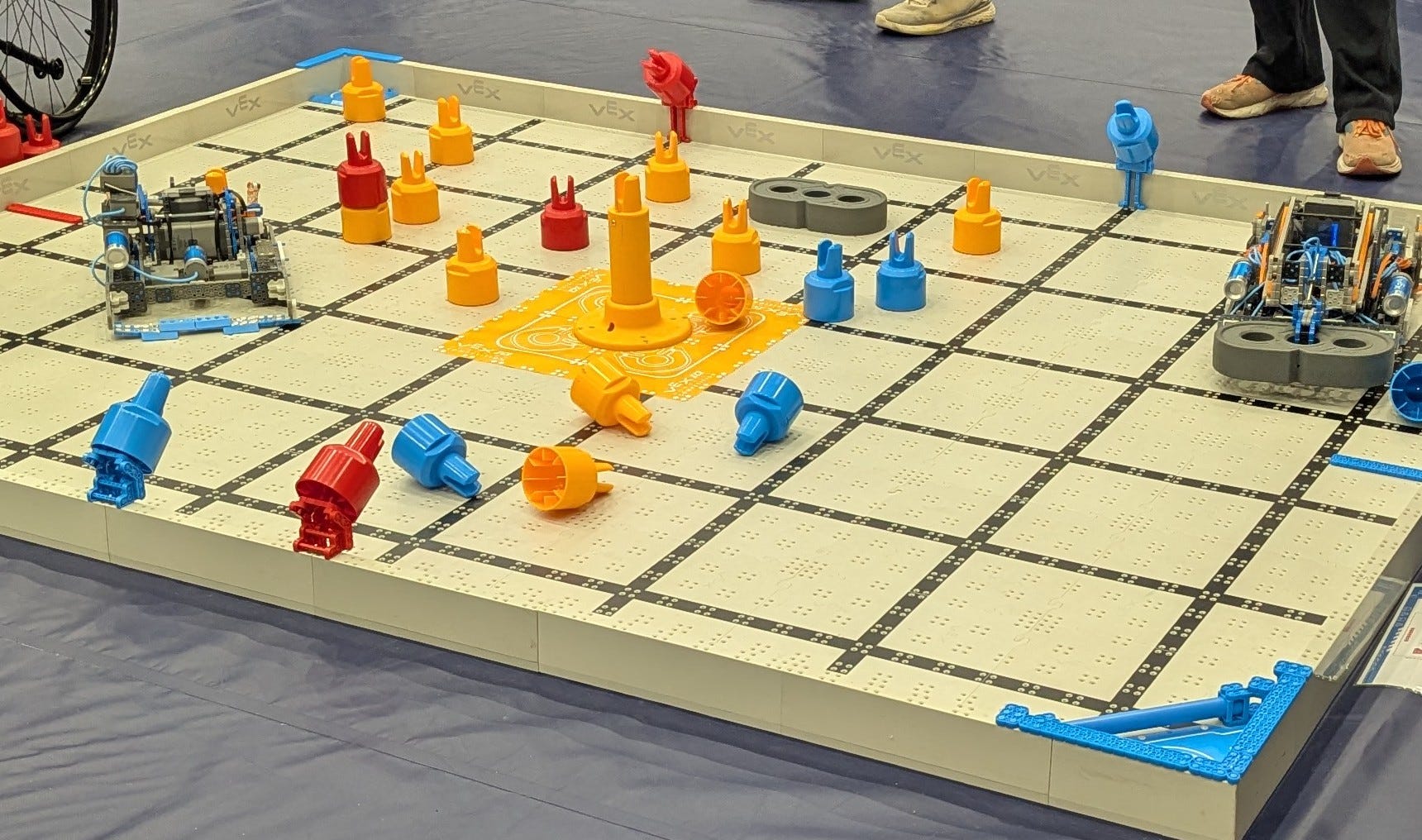
Last year, the robots had to put balls through goals. This year, they have to stack cups. It’s exactly as thrilling as it sounds. It’s fun to see Mae do well at anything, but the event generates little interest on its own merits. This isn’t something I’d watch strangers do on ESPN 3, and I say that as a guy who has watched professional darts. I’m sure the father of the guy who invented the dishwasher felt the same way. It’s possible to marvel at the spectacle and appreciate the thought that went into something without sitting there and watching the machine actually do its job. Or maybe I’m wrong and the dad of the guy who invented the dishwasher was riveted and spent many Saturdays watching the rinse cycle over and over again. We all show our love in different ways.
Some parts of the robotics competition couldn’t be watched, even if I wanted to. There’s an interview where judges talk with the team to prove the kids made the robot themselves and didn’t have adult help. Mae’s team always scores high on that part. I suppose I could help by being close enough for the judges to hear me talking about anything. They’d immediately know I wasn’t smart enough to help with a robot. Any assistance would be an actual hindrance. They should give my kid some bonus points. I couldn’t tell you how Mae’s robot worked. I assume there were gears and pulleys and possibly some magic. That grinding mechanical sound was the trapped fairies trying to get out. Mae ran back and forth throughout the competition, repairing the robot and making small adjustments. At one point, she had to redownload all the programming software. Meanwhile, I watched from a distance and occasionally typed a sentence when I wasn’t too distracted by the internet. Another Saturday well spent.
Saturday would have been a good day for shorter competitions all around. Besides the approaching storm, I also needed to get back to my own suburb for the Pinewood Derby. Waffle’s car weighed in at exactly five ounces thanks to a unique red half circle weight one of the scout masters gave her. I wanted to glue googly eyes to it to complete the look, but there wasn’t a gram to spare and still be under the weight limit. The scout master said he would let it slide, but I didn’t want to flaunt the rules. Our family has a reputation to uphold. I intended for her to lose fair and square. Waffle’s car might have been the right weight, but it had the wrong alignment. The channel for the axles was miscut at the factory. The car drifted and rammed into the side of the track. The scout leaders discovered the error when letting the kids do test runs at the Thursday night Cub Scout meeting. Somehow, they fixed it. People who are good with wood are as magical as cup-stacking robots. The car was still slow, but it ran straight. I just had to make it back in time to see it run Saturday. For that to happen, I needed robotics to end.
It was a near thing, but the timing worked out. Robotics ran ahead of schedule. Mae’s team made the finals but didn’t quite make it to state. We arrived back in our suburb right as the snow was getting bad. I got to the Pinewood Derby in time to see Waffle make all of her runs. For weeks, I’ve been predicting that she would once again win a trophy by default. The pack caught on to our scheme. Instead of letting the two smallest dens race as two groups of three, they made them race as a bigger group of six. Waffle didn’t advance, but she did eat plenty of spaghetti at the fundraising dinner going on at the same time. I call that a win. As soon as she was done racing, I left to pick up Betsy from the high school. Her team had just returned from their truncated competition, where they placed well. By 7 p.m., the whole family was home and hunkered down for the oncoming storm. We owed a huge debt to the volunteers who ran things all day. They let the kids have fun, and they got us out of there before the worst of the snow hit. I couldn’t do what they do. I don’t have it in me to critically score the kids for how well they sang or designed a robot. I would just give everyone a million points and tell them to go home. Actually, maybe I should be the one scoring them. Other parents would love me.
Anyway, that’s all I’ve got for now. Catch you next time.
James
I love the pride in your voice….win, lose or place. Super sweet.
See how sweet you are, James? ;-) Giving everyone a million points and sending them home. I'm the same. I don't mind healthy competition, but when it gets ugly and people are mean and cheat... I'm not a competitive person. I don't really understand super competitive people other than they need some kind of ego boost. That's all I can figure. Sounds like your girls have wonderful hobbies and nice reasonable competitions to be part of. Hope you are staying warm and safe after the storm. We got 17 inches of snow here in central Ohio!